The Madonna Complex: Unboxing Womanhood
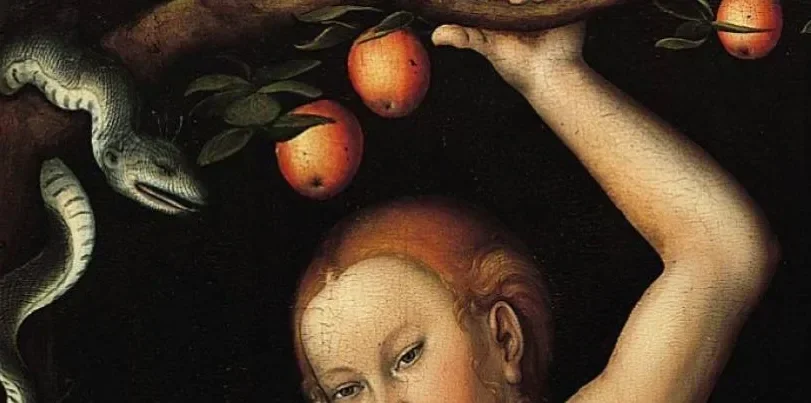
Eve, by Lucas Cranach the Elder c. 1530. Pasadena, California.
June 1, 2026
Having arrived in Guildford, England, a lovely town not far outside of London, I waited at the bus stop and wondered how Cricket even worked. The guy I was seeing at the time invited me to watch his game, but it felt too real, too personal. I regretted the top I wore; it was too small, and I spilled out of it. Hovering and endlessly adjusting the straps, worrying about my looking risque to the townsfolk.
A group of schoolboys walked by, unaware of the rest of the world, dressed in blue uniforms and black shoes. The one at the very back whispered to the others, clearly distraught, “Women are temptresses. All of them! Temptresses!” The rest nodded in agreement. I looked to the older lady next to me, with her greying hair and floral blouse, and grinned as she slowly broke into a fit of laughter. We giggled together until the bus came, entertained by their terror.
Saints
Last Autumn, at the Cricket game, I sat with the athletes’ wives and girlfriends to watch my short-term, non-exclusive, long-distance, unlabeled, low-commitment whatever play. The middle-aged men with their beers and smokes called me his “Mrs.” In the back of my mind, I wanted to say we would be over within a week; having me here was a novelty. I had ridden the train to catch what he built a career out of, one I didn’t know the rules for, playing house for the weekend before I was eventually forgotten. I’d be the girl in the low-cut top with a ditsy American accent in a crowd of Posh in polos. The Whore trying to blend in with the Madonnas.
When I posted my first blog entry nearly a year and a half ago, I wrote about the internal struggle I was having in relation to contemporary hookup culture. At that point in my life, deciding to publish a conversation so personal, so taboo, changed everything. While several messaged, applauding my openness, I also got called trashy, sleazy, just for talking about it. “It” being asking what it would mean to partake, not even an admission of doing so already. I touched on historical context and notes of biblical impact, but the essay was entirely for me, for my choice. This time, I want to dive even deeper— explore why women are subjected to this decision of singularity, and the apparent consequences that follow.
Going back to what many believe to be the first story of humankind: God breathed life into dust and made Adam, then crafted Eve from Adam’s flesh. In biting into the fruit, with their disobedience, temptation, and shame in their nakedness, thus was born the original sin. Eve, in Judeo-Christian tradition, became the face of rebellious sexuality, the promiscuous, whereas the Virgin Mary managed to achieve the ultimate purpose, motherhood, without sullying herself in impurity.
Not personally religious, I first read Genesis in a Twilight-themed hotel room, where Edward Cullen stared down at me (Ironic, considering vampires are symbolic of a corrupted soul, of this erotic figure of penetration and lust, but I digress). I later wrote in my Notes App: “If Eve hath made from Adam’s rib, if Eve hath been born at his desperation for her, for partnership in her, then from thy rib I am expected to hold thee, to kiss and pray and revel. From thy rib I am told to carnalize my sanctioned hips and lay them down in debt to Adam and his asking.”
I was reeling from the sheer weight of expectation placed upon us from the very beginning. Women’s bodies were treated as a historical debt, and, in satisfying this demand, all while flattening our own complexity. Perhaps in threading the needle between saint and sinner, we will finally be seen as whole, but the male gaze does not want us whole. We are playing a game where the rules shift depending on who is watching, and, worse, as women, we are always being watched.
To accommodate what was seen as a man’s encouraged nature and a woman’s destructive behavior, society created a class to absorb the double standard of male desire. In the 4th Century BCE, statesman Demosthenes of Athens, Greece, said,
“Mistresses we have for pleasure, concubines for the daily care of our persons, but wives to bear us legitimate children and to be faithful guardians of our households."(Oration 59)
‘Mistresses, concubines, and wives’—for a singular title of ‘man’. It’s impossible to wrap thousands of years of female objectification in a mere section, yet I have to include here reminders that the sole purpose of a wife was to produce his heir, secure his surname, and maintain his land. The ‘Angel in the House’ became this subservient image of domesticity, bound to nothing of her own. Deviance, or even being unmarried, was seen as dangerous. This mindset would continue, particularly in Victorian society, where women had either fallen to urges or were praised for not possessing sexual urges at all. Sigmund Freud wrote of the complex encompassing this dichotomy. Men, in this theory, instinctively separated women into two categories:
When classified as a “Madonna,” a woman is considered innocent and nurturing. She is respected but, at the same time, seen as untouchable, unsexual. The “Whore” is a woman desired for her assumed promiscuity, yet not identified with commitment. She is imagined in the bedroom, not the altar.
Vulgar in name, the two sides are not split by actions alone, but by presence. It is less about whether she is actually having sex or just appears as though she does. Or can. The assumption comes from adhering to a premature stereotype in their mind, an impression decided for you before saying anything at all. You can be outspoken, shy, put-together, confident, non-threatening, “pure” — all, none.
To be perceived as one of the two groups (the third being a complex human being, seen for all they are) is entirely dependent on expectations being placed on an individual.
Sinners
Partly why I took my website down and gave myself space away from it is that to think of my parents, my extended family, knowing I’m capable of even acknowledging the concept of sex, feels wrong, indecent. Or a lover reading it and further believing me to be too far to one side of this so-called spectrum of morality.
That fear echoes exactly the point I am trying to make— we have built this cage of righteousness ourselves and cannot escape it.
Not to say we should all bathe in gardens of pleasure (of course, go ahead), or live a life of celibacy (again, by all means) —but rather that women not be forced into these one-dimensional judgements. Aware of what is possible flippancy and obvious bias, I often think it comes down to fear. Men want to play with their swords– and, well, their other swords– while women are made entirely of power and life. Beings of miraculous remarkability. Desperate for dominance, men control our autonomy as their weapon. And they are at the mercy of this system, too. The cage entraps us all.
Lost in a rabbit hole of this topic with my friend, we compared notes on how Freud’s complex impacts us. We share the same views on sex-positivity and feminism, yet men often immediately assume her a puritan, and me, a trollop. I tend to make dirty jokes, talk openly about my dating life, and my clothes, pushing against a slightly curvier frame, come across as immodest.
This places me into a big red box with “DO NOT TAKE SERIOUSLY” written in large, bold lettering. Rather than “Wow, look at this woman, both capable of sexuality and of great substance. How remarkable! The nuance!”
In realizing this phenomenon, in trading our assigned identities late at night, buzzed on wine, I thought of how suffocating it all was. She felt exhausted by this fragile, delicate image that rid her of vulgarity, and I could no longer breathe in this dress of repulsion.
We decided to hold an experiment. One night, we both dressed similarly for a band show, clad in boots and jackets(!!). When approached by men, we proceeded to ask a list of research questions: “Between the two of us, which would be a virgin? Who’d cheat on their partner? Who is looking for a relationship? Who has casual sex?”
Before we revealed any glimpse of our personalities to these strangers, they ascribed each sinless answer to her and each sinful one to me. Presumptions made in mere seconds. Our hypothesis proved true.
Redemption
Why, after all this talk of ridding ourselves of the male gaze, does any of this matter? Why give a ridiculous notion any time of day? It’s frustrating, in any context, to be allowed one quality. Before college, I had been labeled as oversensitive, overemotional, and overreactive. This constant use of “over” threw me far across the bridge of normality, emphasizing that I was too much. I’d run to the bathroom to hide my tears during class, terrified of showing how quickly and to what degree everything seemed to impact me. I felt like this glass always cracking.
Over time, I worked to be more confident, more unaffected— escaping before someone viewed me as vulnerable, pulling away to avoid being considered porcelain again. Hypersexuality can be a defense mechanism, quieting panic with short-term flashes of dopamine to remain apathetic in relationships. And childhood traits can be shed, left behind, and transformed into making indecent jokes. A display of identity through sensuality or a love for utter raunchiness. The need for it to be only one thing is tiring, boring.
Recently, at a dive bar in Los Angeles, a man offered to buy me a drink, flirting openly. I enjoy chatting with a stranger and, even more so, getting a free cocktail, though I often come across as closed off and uninterested at first. On several occasions, I have been told I am “hard to read,” “a closed book,” on first dates (Sorry, person I just met. Should I have opened with something else?). This guy decided to analyze me. “You seem jaded,” he said. “Let me guess: someone hurt you, and now you no longer trust men.”
Appalled, I wanted to criticize this interpretation that not being all over him in seconds creates some proof I am a broken, cynical woman. That flinching at his brazen touch makes me mean. Instead, I just forced a smile, “Nailed it.” Upon seeing me, he immediately placed me in a category (I’m sure you can guess which) and then, within minutes of a conversation, realized I didn’t perfectly fit inside it and needed an excuse. He spun a narrative where my boundaries were a defect, preferred something neat and identifiable. I got under his skin with being a little “complicated.” Annoyed him by not flirting back.
Eve, as a symbol, challenges humanity out of a naivety in disregarding complexity. A ‘Mrs.’ to someone, ‘jaded’ to another. The schoolboy’s shaky “temptresses,” the woman who turned to me, amused, sharing this inside joke.
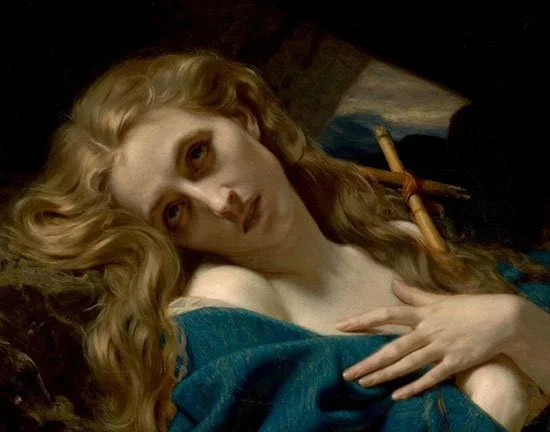
Mary Magdalene in the Cave, by Hugues Merle, c. 1868
